D's 3-Day Gym Plan
Sized for 227 lb · 12-week block · as of 20 September 2026 · built on Bryan Johnson's Blueprint protocol and Anatoly's lifting method
Goals and the honest math
Target: 11 lb of fat gone in 10–12 weeks (about 1 lb/week), muscle held or slightly up, waist visibly smaller. Three 60-minute gym sessions plus two 60-minute yoga sessions is enough training — the gym drives muscle, the kitchen drives the 11 lb.
| Goal | What actually moves it | Weight in this plan |
|---|---|---|
| Lose 11 lb | A 500–600 kcal/day deficit held for 10–12 weeks; training adds only ~1,200–1,800 kcal/week at your size | Nutrition first, training second |
| Keep and build muscle | Heavy compound lifts, every muscle group twice a week, progressive overload, 165–185 g protein/day | All three gym days |
| Visible abs | Body fat low enough (roughly ≤12–14% for men) plus a trained rectus abdominis and obliques | Deficit + loaded core work every session |
| Belly fat specifically | Cannot be spot-reduced; it leaves with overall fat loss, moderate-to-hard cardio, sleep, and lower chronic stress | Deficit, intervals, Zone 2, sleep, yoga |
What we borrow from Blueprint and Anatoly
Blueprint supplies the weekly skeleton and the cardio; Anatoly supplies how to lift. They disagree on volume (Johnson trains daily, Anatoly lifts heavy four days and rests three), so this plan takes the structure that fits three sessions.
| Principle | Source | How it shows up here |
|---|---|---|
| Every session = warm-up, compound strength, then cardio | Blueprint protocol: 10 min warm-up, 20–30 min strength, cardio | Each day ends with a 6–18 min conditioning block |
| Norwegian 4×4 intervals raise VO2max (22% in the cited study) | Blueprint, Day 6 | Day C finisher: 3 × 2 min at 85–95% max HR on the bike |
| Zone 2 steady state at 60–70% max HR | Blueprint | Day A finisher, plus walking after meals |
| Move 5–10 min after meals; break up sitting every 30 min | Blueprint | Daily habit in the belly-fat section |
| Mobility and yoga preserve movement patterns | Blueprint, Days 3 and 7 | Your two yoga sessions cover this; no extra stretching needed |
| Heavy compounds first, pyramid up to 3–5 reps | Anatoly's routine: squat, bench, deadlift each get a day | Each gym day opens with one main lift at 4–5 reps |
| Accessories taken close to failure at 6–15 reps | Anatoly | Second and third exercises run 8–12 reps, 1–2 reps shy of failure |
| Pull-ups, dips, hyperextensions, leg raises as staples | Anatoly, Day 4 | Pulldowns/pull-ups and dips on Day B, hanging leg raises on Day A |
| Strength without bulk: 639 lb deadlift at 172 lb bodyweight | Wikipedia | Strength is the metric, not scale weight |
| Consistency and recovery beat novelty | Both | Same three sessions for 12 weeks, deload in week 7 |
Weekly schedule
Lift Monday, Wednesday, Saturday; yoga Tuesday and Thursday; Friday and Sunday off. Every lifting day gets a day of recovery before the next.
| Day | Session | Duration | Why here |
|---|---|---|---|
| Mon | Gym A — Lower body + core | 60 min | Fresh after Sunday off, heaviest legs day |
| Tue | Yoga | 60 min | Active recovery for hips and hamstrings |
| Wed | Gym B — Upper push/pull + core | 60 min | Legs rest, upper body works |
| Thu | Yoga | 60 min | Mid-week mobility, breathing, stress down |
| Fri | Off (walk 30+ min) | — | Rest before Saturday's hardest session |
| Sat | Gym C — Full body + intervals | 60 min | Fresh legs and weekend time for the hardest conditioning |
| Sun | Off (walk 30+ min) | — | Full rest |
Swap days freely, but keep at least one day between gym sessions and keep Day C before a rest day. If a week collapses to two gym sessions, do A and B and skip C — those two cover every muscle group.
Day A — Lower body + core
Monday57–60 minOne heavy squat, a hinge, then unilateral and core work, and a Zone 2 finish. Click any picture for a form video.
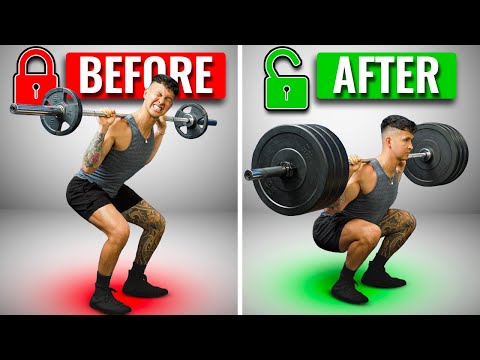
How to
Move: break at the hips and knees together, sit down between your hips until the thighs are at least parallel, then drive the floor away through your whole foot.
Tempo: ~2 s down, brace at the top of every rep; exhale through the hardest part.
Cue: chest proud, knees tracking over the toes, heels planted. Avoid: knees caving in or heels lifting — rack it before form breaks.
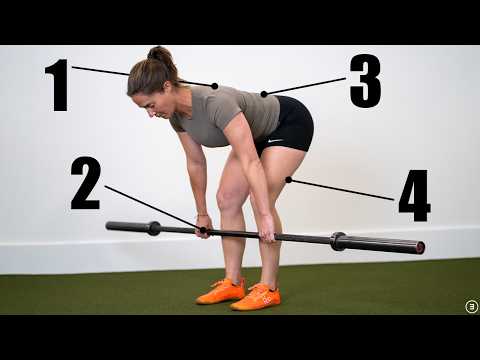
How to
Move: push your hips straight back and let the bar slide down your thighs until you feel a strong hamstring stretch just below the knee, back flat throughout; squeeze the glutes to stand tall.
Cue: bar stays glued to the legs, hips travel back not down. Avoid: rounding the lower back or turning it into a squat — stop at the stretch, not the floor.

How to
Move: drop straight down until the front thigh is roughly parallel and the back knee nears the floor, then drive up through the front heel with most of your weight on the front leg.
Cue: slight forward torso lean, front knee tracking over the foot. Avoid: pushing off the back foot. Finish all reps on one leg, then swap.
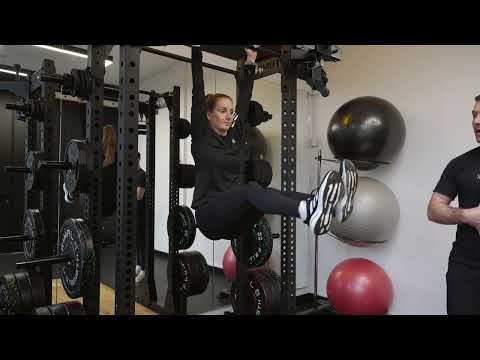
How to
Move: curl your pelvis up and raise your knees (or straight legs) toward your chest using the abs, then lower slowly under control.
Cue: think ‘roll the hips up’, not ‘lift the legs’. Avoid: swinging — if you kip, do bent-knee raises until you can do 12 clean straight-leg reps.
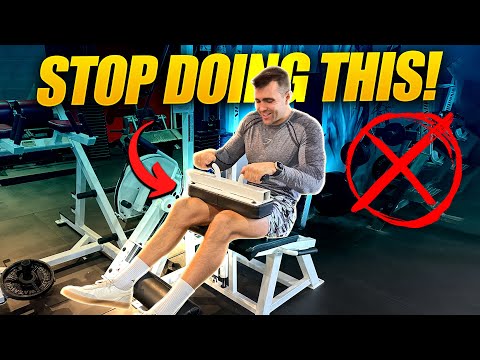
How to
Move: curl your heels fully under, pause a beat, then return over ~3 seconds resisting the whole way.
Cue: own the negative — that slow return is where the growth is. Avoid: slamming the weight back or letting the thigh pad ride up.
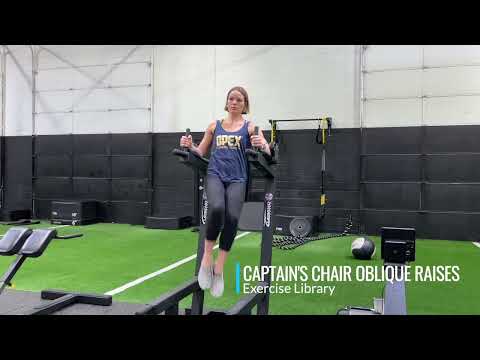
How to
Move: lift your knees and steer them toward one side (the obliques do the twist), lower slowly, and alternate sides each rep.
Cue: controlled, no swinging — feel it in the side of the waist. No captain's chair? Lie on a bench, hold behind your head, and do the same twisting leg raise.
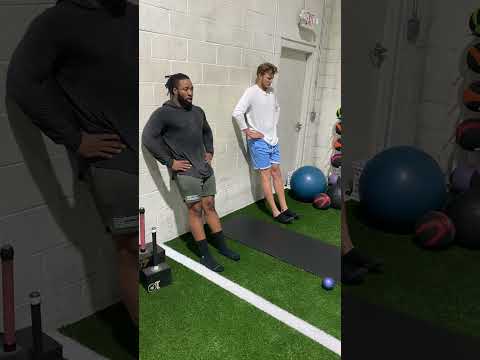
How to
Move: pull your toes up toward your shins as far as they go, squeeze the front of the shin at the top, then lower slowly and repeat.
Cue: heels stay down; feel the burn in the front of the shin. Progress: step the feet further from the wall, or hold a plate on the toes. Avoid: bouncing — control both directions; 15–30 reps is normal for this small muscle.

How to
Gauge it (talk test): you can hold a full conversation but wouldn't want to sing; nose-breathing is just about possible.
How: incline treadmill walk (joint-friendly at 227 lb) or an easy bike — pick an incline/resistance that keeps you in the zone and hold it steady, no surges.
Rough max HR ≈ 220 − age; your band is 60–70% of that.
Day B — Upper push/pull + core
Wednesday58–60 minHeavy bench and a heavy vertical pull, then pressing and rowing paired to save time, core, and a short interval finish. This is the tightest day, so keep rests honest.

How to
Move: lower under control to the lower chest with elbows about 45–75° from the torso (not flared to 90°), touch, then press up and slightly back over the shoulders.
Breath: big breath at the top, hold it through the descent and press. Avoid: bouncing off the chest or flaring the elbows. Use a spotter or the safety pins on the top set.
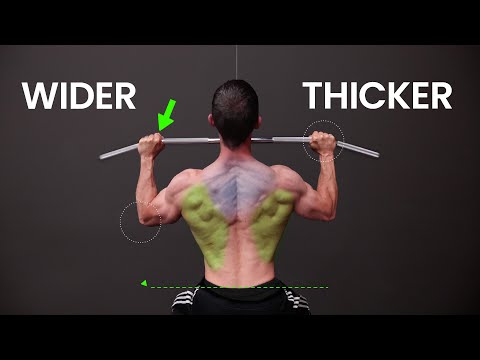
How to
Move: drive the elbows down and back to bring the bar to your upper chest, squeeze the lats a beat, then control it all the way back up.
Cue: lead with the elbows, chest up, minimal lean-back. Progress: once you can do 6 clean bodyweight pull-ups switch to those; add weight past 8. Avoid: heaving with momentum or a half return.

How to
Move: press straight up, moving your head back slightly to clear the bar then ‘through the window’ so it finishes stacked over the mid-foot, biceps by the ears.
Cue: squeeze the glutes to stop yourself leaning back. Avoid: arching the lower back into an incline press — brace and press with the shoulders.

How to
Move: pull the handle to your navel by driving the elbows back, squeeze the shoulder blades together for a second, then return to a full stretch under control.
Cue: chest up, torso still. Avoid: rocking back and forth for momentum — the torso barely moves.

How to
Move: lower under control until the upper arms are about parallel (shoulder comfort permitting), then press back to lockout.
Cue: elbows travel back, not flared wide. Scale: use the assisted-dip machine if 8 reps aren't clean; add weight only past 12. Avoid: going so deep the shoulders roll forward — stop 1–2 reps shy of failure.
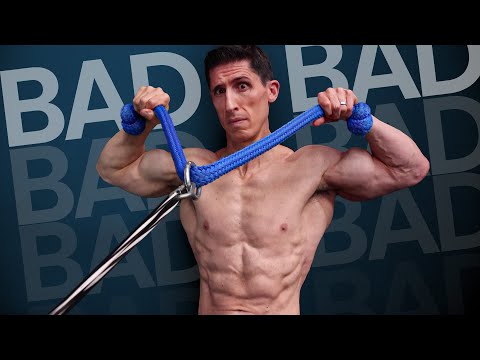
How to
Move: pull toward your forehead, spreading the hands apart and rotating until your knuckles face behind you; squeeze the rear delts, then return slowly.
Cue: high elbows, pull to the face not the chest. Avoid: going heavy and turning it into a row — this is shoulder insurance, keep it strict and light.
How to
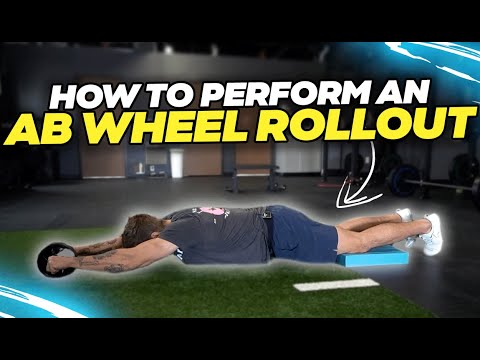
Move: roll forward only as far as you can keep the lower back flat — the instant the hips sag or the back arches, you've gone too far; pull back with the abs, not the arms.
Cue: ribs down, glutes squeezed throughout. Avoid: letting the lower back dip into extension — shorten the range instead.
How to
Move: walk ~30 m with short, quick, controlled steps, staying tall the whole way; set down, rest, repeat.
Log the weight per hand and the distance. Cue: grip hard, don't lean. Avoid: shuffling with a slumped, rounded posture — reset if form breaks.

How to
Intensity: the 20 s efforts are genuinely hard (~90%+ effort, fast and powerful); the 10 s is barely-moving recovery, not a full stop.
How: assault bike or rower (no jumping — kinder to the knees at your weight).
Pacing: aim to hold about the same output every round — if round 8 is far weaker than round 1, you started too hot.
Day C — Full body + Norwegian intervals
Saturday50–52 minHeavy deadlift, a quick full-body circuit, then the week's VO2max work: three 2-minute hard efforts on the bike.
How to
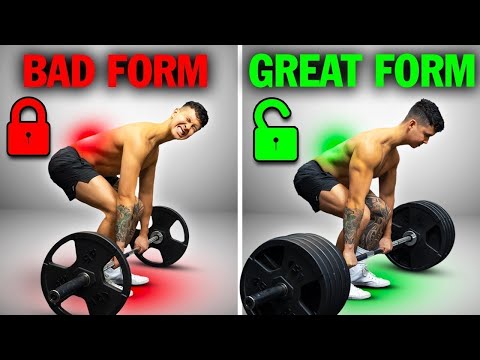
Move: push the floor away with the bar dragging up your legs, hips and shoulders rising together; stand tall and lock out with the glutes — don't lean back.
Every rep resets: no touch-and-go — set it down, re-brace, pull again. Avoid: rounding the lower back or letting the hips shoot up first; if the back rounds, drop the weight.
How to
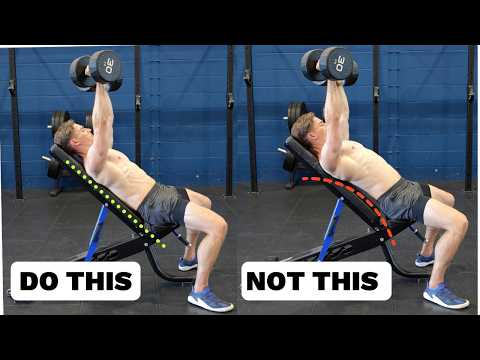
Move: press up and slightly together until the arms are nearly locked, then lower under control to a full stretch at the bottom.
Cue: elbows about 45° from the torso, wrists stacked over the elbows. Avoid: clanking the dumbbells at the top or bouncing out of the bottom.

How to
Move: step forward into a long stride and lower until the back knee nearly kisses the floor and the front thigh is about parallel, then drive through the front heel straight into the next lunge.
Cue: torso upright, front knee over the foot, long stride (short strides hammer the knee). Avoid: leaning forward or letting the front knee cave inward.

How to
Move: row the dumbbell to your hip by driving the elbow back and up, squeeze the lat, then lower to a full stretch.
Cue: pull to the hip (not the shoulder), keep the torso square. Avoid: twisting the torso to heave the weight up.
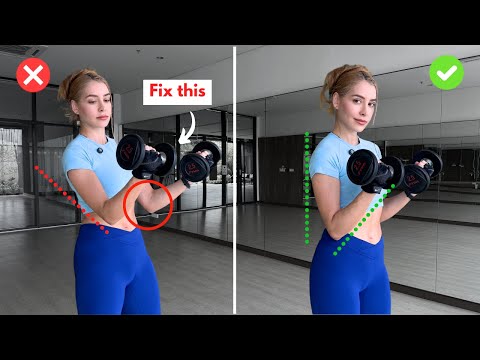
How to
Move: curl up while rotating your palms to face your shoulders at the top (that twist is part of the biceps' job), squeeze a beat, then lower over 2–3 seconds to a full stretch.
Cue: keep the elbows fixed in one spot — only the forearm moves. Avoid: swinging the torso, flaring the elbows, or cutting the range short; pick a weight you can control for 12 clean reps.
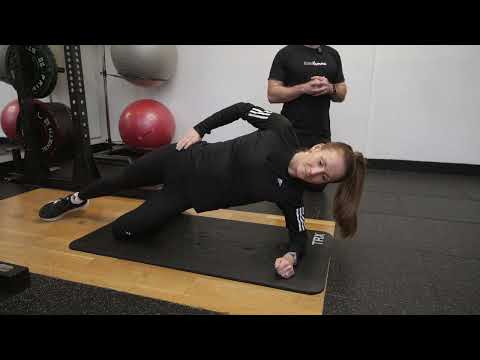
How to
Move: lift the hips so the body is one straight line from head to heels; hold for time breathing normally, then switch sides.
Log the seconds held per side. Cue: hips high and stacked. Too hard? Bend the knees and hold from there. Avoid: letting the hip sag toward the floor or rolling forward.
How to
The 2-min effort: aim for 85–95% of max HR, an RPE ~8–9. Because the effort is short, drive up into the zone quickly — by ~30–45 s in — rather than pacing the start, so you still bank real time near the top.
The 2-min recovery: spin or row very easy until your breathing comes back down — keep moving, don't stop dead.
Why shorter still works: a small dose of hard intervals (≤10 min of intense work) drives most of the VO2max gain, and shorter efforts accumulate similar time at high heart rate with less overall strain — so 3 crisp 2-min rounds beat 3 draining 4-min ones and leave you fresher for the week.
No HR strap? Go by feel (hard-but-finishable, only short bursts of speech). Machine: bike or rower, not treadmill, at 227 lb. Rough max HR ≈ 220 − age.
Feeling strong? Add a 4th round or push the watts before you lengthen the intervals.
If the deadlift session ran heavy and you have nothing left for the intervals, do 2 rounds well rather than 3 badly. Rough max HR: 220 minus age; a chest strap is more accurate than a wrist.
Progression over 12 weeks
Main lifts progress by load, accessories by reps, and week 7 is a deload. In a calorie deficit the realistic win is holding or slightly raising your lifts while 11 lb comes off — if strength is climbing, you are not losing muscle.
| Weeks | Main lifts (squat, bench, pulldown/pull-up, deadlift) | Accessories | Cardio finishers |
|---|---|---|---|
| 1–2 | Find a weight for 4×5 (4×4 deadlift) with 1–2 reps in reserve | Pick loads that make the top of the rep range hard | Run as written; log heart rate and bike watts |
| 3–6 | Add 5 lb/week to squat and deadlift, 2.5–5 lb to bench, one plate step on the pulldown; when a set fails, repeat that weight next week | Double progression: hit the top of the range on all sets, then add 5–10% | Zone 2: +2 min every 2 weeks. Norwegian: raise the watts, not the time |
| 7 | Deload: same exercises at 60% of week-6 loads, 2 sets each | Same, 2 sets | Zone 2 only, skip intervals |
| 8–11 | Switch main lifts to Anatoly's 5×3 pyramid: 5 sets climbing to a top triple, add 5 lb/week | Continue double progression; swap one accessory per day if bored | Norwegian: push the watts, or lengthen the hard efforts toward 3 min |
| 12 | Test week: work up to a heavy 3 on each main lift and record it | Light | Easy |
Rules: never add weight at the cost of form; if sleep was under 6 hours, drop the top set rather than skip the session; if two sessions in a row feel flat, take the deload early.
Nutrition for the 11 lb cut, sized for 227 lb
Eat about 500–600 kcal/day under maintenance and 165–185 g protein/day; that is the whole strategy. At 227 lb your maintenance is probably around 2,900–3,100 kcal (approximate — it depends on height, age and how much you walk), so the target is roughly 2,400–2,500 kcal/day. That gives a deficit of about 3,500–4,000 kcal/week, which is about 1 lb of fat/week and 11 lb in 10–12 weeks.
| Lever | Target at 227 lb | Why |
|---|---|---|
| Calories | ~2,400–2,500 kcal/day to start. Confirm in week 2: track intake and weight for 14 days; if the weekly average isn't dropping 0.9–1.5 lb, adjust by 150 kcal | Fast enough to finish in 12 weeks, slow enough to keep muscle and lifts. A 5% bodyweight loss at your size tolerates a slightly larger deficit than a lighter person's would |
| Protein | 165–185 g/day (0.7–0.8 g/lb), spread over 4 meals of 40–50 g | Morton et al. 2018 found muscle gains plateau around 1.6 g/kg (0.73 g/lb). At a higher bodyweight the need tracks lean mass, so 0.7–0.8 g/lb covers it without forcing 200+ g down every day |
| Fat | 75–90 g/day, mostly olive oil, nuts, fish | Hormone health; below this cuts feel worse than they need to |
| Carbs | The remainder: ~220–260 g on gym days, ~150–180 g on yoga and rest days, most of it in the meals before and after training | Fuels the heavy sets and the intervals; Anatoly cycles carbs by training load |
| Fibre and volume | 35–40 g fibre; vegetables, legumes, berries at every meal | Fullness per calorie — the Blueprint plate is mostly this |
| Alcohol | Zero or near-zero for 12 weeks | Empty calories, worse sleep, and it directly favours abdominal fat storage |
| Eating window | Finish dinner 3+ hours before bed; a Blueprint-style early last meal | Better sleep, which is a belly-fat lever in its own right |
| Creatine | 5 g/day, any time | Anatoly's one staple supplement; keeps strength up while cutting. Expect +2 lb of water in week 1 — it is not fat |
What a 2,450 kcal, 175 g protein day looks like
| Meal | Example | Approx. |
|---|---|---|
| Breakfast | 4 eggs + 100 g egg whites scrambled, 2 slices sourdough, tomatoes, berries | 620 kcal · 48 g protein |
| Lunch | 200 g chicken thigh or fish, 150 g cooked lentils or farro, big salad with 1 tbsp olive oil | 680 kcal · 55 g protein |
| Pre/post-gym | 250 g Greek yogurt (2%), 1 banana, 20 g nuts | 420 kcal · 28 g protein |
| Dinner | 200 g lean beef, white fish or prawns, 200 g roast vegetables, 120 g cooked rice or potatoes, olive oil | 730 kcal · 50 g protein |
Your Mediterranean cooking already fits this: lean protein, legumes, olive oil, vegetables. The change is portion arithmetic, not a new cuisine. Weigh yourself daily and average the week; if the weekly average drops more than 2 lb for two weeks running, add 150–200 kcal back — faster than that starts costing muscle.
Belly fat and abs
Belly fat leaves through the deficit and moderate-to-hard cardio, not through ab exercises; the ab work in this plan builds the muscle that shows once the fat is gone. Visceral fat (behind the wall, pushes the belly out) goes first and responds strongly to cardio; subcutaneous fat (the pinchable layer) is last to go and only the deficit moves it.
| Works | Evidence / source | In this plan |
|---|---|---|
| Moderate-to-high intensity aerobic work | Vissers et al. 2013 meta-analysis: aerobic training cut visceral fat by >40 cm² in men within 12 weeks, even without calorie restriction; low intensity did not | Norwegian intervals (Day C), Tabata (Day B), Zone 2 (Day A) |
| Sustained calorie deficit | The only thing that removes the subcutaneous layer over the abs | Nutrition section |
| Sleep 7–9 h | Short sleep raises cortisol and appetite; both push fat to the abdomen | Early dinner, fixed wake time |
| Stress down | Chronic cortisol favours visceral storage | Two yoga sessions, Blueprint's meditation habit |
| Walking after meals, 5–10 min | Blueprint's daily rule; blunts the glucose spike and at 227 lb burns 120+ kcal/day with no recovery cost | Every day, after lunch and dinner |
| Loaded ab and oblique work 2–3×/week | Abs grow like any muscle: progressive load, 8–15 reps | Hanging leg raises, captain's chair twists, ab wheel, side plank across the three days |
| Does not work | Why |
|---|---|
| Crunches every day for spot reduction | Fat loss is systemic; no study has shown local fat loss from local exercise |
| Waist trainers, sweat belts, fat-burner pills | Water loss or nothing |
| Cutting carbs entirely | You lose glycogen water and your lifts, not extra belly fat |
| Extra low-intensity cardio | The meta-analysis above found low intensity does not move visceral fat |
The honest timeline at 227 lb: the first 11 lb takes the belly down noticeably and shows upper abs in good light. A defined six-pack at your size most likely needs a second block — 4 weeks at maintenance after week 12, then repeat the same plan for another 8–10 weeks. Extend rather than cut harder.
Tracking and checkpoints
Track four numbers weekly; the scale alone will lie to you when muscle and fat move at once.
| Measure | How | Green | Adjust when |
|---|---|---|---|
| Weekly average weight | Daily, morning, after bathroom, averaged Sunday | Down 0.9–1.5 lb/week | Flat 2 weeks: cut 150 kcal. Down >2 lb two weeks running: add 150–200 kcal |
| Waist at the navel | Tape, relaxed, Sunday morning | Down about 0.5–1 cm/week | Flat while weight drops: fine, fat is coming off elsewhere first |
| Main lift loads | Logged every session | Holding or rising | Two consecutive drops on the same lift: check sleep and protein, then deload |
| Norwegian interval watts | Power or speed held for the 4-min blocks at the same HR | Rising every 2–3 weeks | Falling: under-recovered, drop to 2 rounds for a week |
Checkpoints
- Week 2: maintenance calories confirmed from the data, all working weights set, week-0 photos and waist measurement taken
- Week 4: about 223 lb, waist 2–3 cm smaller, no lift lost
- Week 7: deload; photos front and side in the same light as week 0
- Week 8: about 219 lb; decide whether to hold calories or trim 100 kcal
- Week 12: 216 lb, heavy-triple test on squat, bench, deadlift; compare photos and waist to week 0; decide on block two
Sources
- Bryan Johnson — Exercise and Fitness Protocol for Longevity — weekly structure, Norwegian 4×4, Zone 2 and HIIT prescriptions, post-meal walks
- Anatoly (Vladimir Shmondenko) workout routine — Dr Workout — pyramid main lifts at 3–5 reps, accessories to failure, staple bodyweight and core moves, creatine
- Vladimir Shmondenko — Wikipedia — best lifts and bodyweight
- Anatoly's official programs — his stated approach to cutting, core, and self-coaching
- Morton et al. 2018, BJSM — protein intake and muscle gain with resistance training
- Vissers et al. 2013, PLOS One — exercise type and intensity versus visceral fat
- Gillen & Gibala 2013, Appl Physiol Nutr Metab and Poon et al. 2024, Scand J Med Sci Sports — low-volume HIIT (≤10 min of intense work per session) raises cardiorespiratory fitness about as well as higher-volume protocols; basis for the shorter 3 × 2-min Norwegian block
- Astorino et al. 2022, Res Q Exerc Sport — shorter high-intensity intervals accumulate more time above 85% of peak heart rate and feel easier than longer ones; supports halving the work interval while keeping the rounds
- Form videos: Jeff Nippard (squat, bench, deadlift), Squat University (Bulgarian split squat, seated leg curl, seated cable row, dumbbell row, face pull), Renaissance Periodization, NASM and others, linked on each exercise card
Maintenance calories, body-fat percentages for visible abs, sleep and cortisol effects, and the ab-visibility timeline are estimates from general training knowledge, not tied to a single study. Height and age would tighten the calorie estimate.